
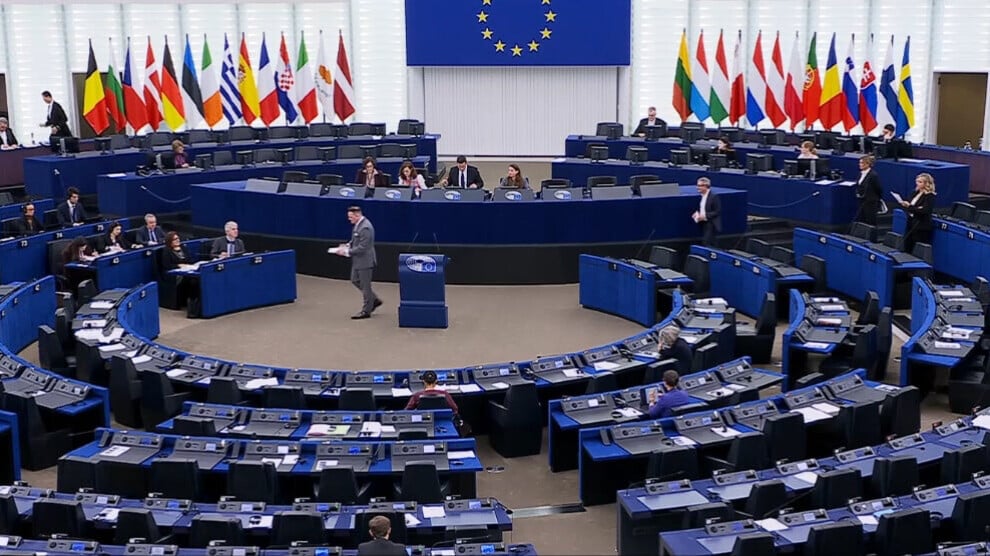
On 10 February 2026, the European Parliament held a debate titled “The situation in Northeast Syria, the violence against civilians, and the need to maintain a sustainable ceasefire.” Speakers from across the political spectrum condemned recent attacks on Kurdish communities in Northeast Syria and Aleppo by the Syrian Transitional Government and Turkey, and reaffirmed support for a sustainable ceasefire. Many MEPs stressed that silence in the face of such violence amounts to complicity. The debate marked a rare moment of cross-party convergence in support of Kurdish rights in Syria.
Key points raised during the debate included:
1. The EU’s responsibility to protect the Kurds: MEPs emphasised that the EU must not abandon the Kurds, highlighting in particular its responsibility to stand with Kurdish women. The Autonomous Administration of North and East Syria was repeatedly cited as a credible model of democratic, pluralistic governance that should inform Syria’s future.
2. Humanitarian access and the lifting of the siege on Kobane: Speakers called for the immediate lifting of the siege on Kobane and unhindered access for humanitarian aid to affected regions.
3. EU funding must be conditional on human rights: As the largest provider of humanitarian and development assistance to Syria, the EU wields significant leverage. MEPs stressed that EU funding—including the €620 million support package announced by European Commission President Ursula von der Leyen during her 9 January visit to Damascus—must be strictly conditional on respect for human rights and an inclusive political transition, and must not be used to entrench an Islamist or authoritarian regime.
4. Constitutional guarantees for Kurdish rights: MEPs insisted on constitutional protections for Kurdish civic and educational rights, political participation, and self-governance. Kurds and other minorities must be meaningfully represented in all structures of governance.
5. Peace and stability as a shared security interest: Peace and stability in Syria—particularly in the northeast—are essential to both regional and European security. The resurgence of ISIS or other jihadist groups poses a direct threat beyond Syria’s borders. MEPs underscored that Kurdish forces have been reliable partners in the fight against ISIS, at the cost of thousands of lives, and argued that protecting Kurdish communities is essential to countering future security risks. Security and democracy, they stressed, are inseparable.
6. Condemnation of the al-Sharaa transitional government: Several speakers warned that the al-Sharaa transitional government—led by Ahmed al-Sharaa, also known as Abu Mohammed al-Jolani—continues to reflect a jihadist mindset. MEPs noted his past affiliation with al-Qaeda–linked groups, as well as similar backgrounds among elements of the current transitional government and armed forces.
7. Turkey’s role in attacks on Kurdish communities: MEPs highlighted Turkey’s direct involvement and support for attacks against Kurds in North and East Syria. Some called for sanctions or increased diplomatic pressure to hold Turkey accountable for human rights violations and potential war crimes.
8. The need for inclusive governance in Syria: Across the debate, speakers stressed that any future Syrian government must be inclusive and representative of the country’s ethnic and religious diversity, with binding constitutional guarantees for the rights of all minorities.
At the end of the debate, Commissioner Dubravka Šuica stressed that Kurds are an essential part of the social fabric of society, and the need for the full protection of Kurdish rights through an inclusive transition process and national reconciliation. Regarding funding, she explained that the 620 million support package would not go to the transitional government, but to vetted contractors and civil society actors. Finally, she indicated that federalism was, in the Commission’s perspective, an interesting proposal for the future of Syria.