
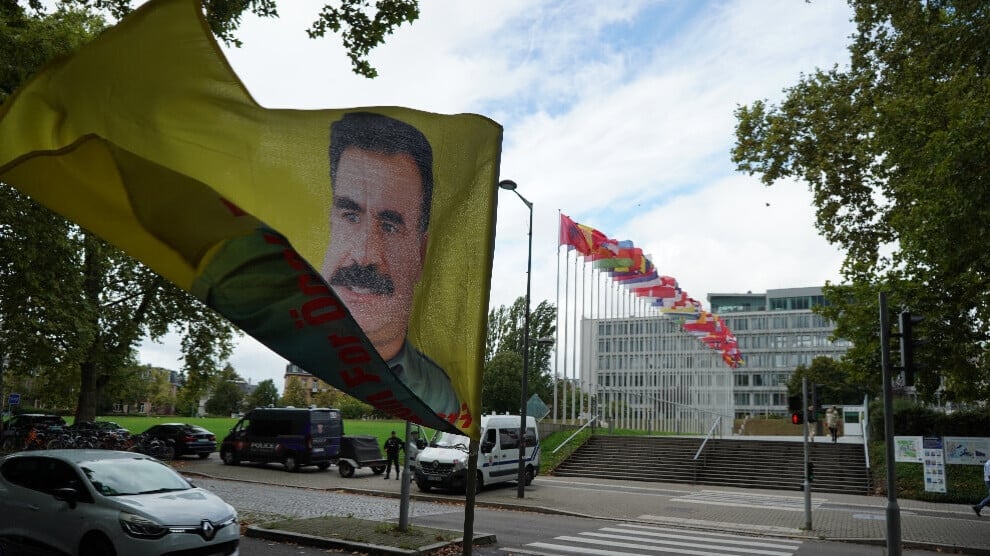
Law in Turkey has never protected those outside the imposed notion of “Turkishness,” and the Kurdish question has always been political and requires a political solution.
If the process is to evolve towards peace and a solution, issues such as what democratic law truly means, how the legal rights of Kurds will be established and how constitutional and international legal guarantees will be ensured must be brought into discussion. Moreover, this must not be done through the existing legal framework in Turkey, but from the perspective of universal and necessary principles of law.
There are two major problems concerning Abdullah Öcalan within the framework of the “right to hope”:
* The way Turkey approaches the law regarding Kurds,
* The fact that the Council of Europe has been slow in addressing the matter.
In fact, legally, in the case of Öcalan v. Turkey, the European Court of Human Rights (ECtHR) ruled in March 2014 that a person cannot be held in prison for life without the possibility of release. In connection with this ruling, it later emphasized the principle of the right to appeal, in parallel with changes in political and social conditions over time. Within this framework, it proposed a mechanism for the review of the case.
Delayed call by the Committee of Ministers
The body responsible for ensuring the implementation of the judgments of the ECtHR by member states is the Committee of Ministers of the Council of Europe. The Committee of Ministers monitors whether these rulings are put into effect. If a judgment is not implemented, it keeps the issue on the agenda before the Council of Europe and applies the necessary procedures with the state concerned to seek a solution. Mr. Öcalan’s case has been before the Council of Europe since 2015. Despite this, the Committee of Ministers made its first serious call to Turkey only in 2021. However, this call did not impose any significant sanction on Turkey; rather, it remained in the form of a recommendation. The issue was brought back onto the agenda in a more serious manner in September 2024, when the Council of Europe called on Turkey to review the judgment concerning Mr. Öcalan within the framework of the “right to hope” and to introduce the necessary legal amendments to enable this right to be realized.
The Committee did not even issue a strong warning
Turkey has made no legal amendment on this matter. Not only does Turkey lack any intention of doing so, but it also does not feel sufficient pressure from the Council of Europe. As a result, it continues to act comfortably without showing even the slightest indication of willingness to introduce such legislation. Mr. Öcalan’s case came before the Council of Europe once again in September. Unfortunately, instead of taking a serious decision, the Council merely issued a recommendation to Turkey. In fact, according to its own internal regulations, the Council of Europe should have made a strong and serious call to Turkey. A commission should have been established regarding Turkey, and a strict monitoring process should have been initiated by this commission. Clear and firm warnings should have been issued, stating that Turkey would face severe sanctions if it failed to comply with the ECtHR ruling.
The issue has been political from the very beginning
In reality, law in Turkey has never included those outside the imposed notion of “Turkishness.” Its legal basis has never been questioned or debated. Therefore, it is impossible to speak of any “law of nations” or a legal system that protects ethnic identities other than “Turkishness.” Such a legal culture, legal construction or legal perspective has never existed in Turkey. For this reason, only one form of law exists, namely “the law of the Sunni White Turk.” In this context, the Kurdish question, the heavy sentence imposed on Mr. Öcalan, the prosecution of Kurdish politicians and the accusation of terrorism against all those who struggle for Kurdish rights, regardless of their method or level of engagement are entirely the result of this mentality. Since there is no such thing as Kurdish law, the issue has been political from the outset; it is not a legal matter. Even if it were to be approached as a legal matter in Turkey, it would still be confined within the framework of the “law of the White Turk,” and this law contains no humane principles whatsoever.
The solution will also be political
In civilized countries, accusations based on thought, freedom of expression, the law of nations or ethnic identity are not accepted, and there is no such concept as a “political crime.” Therefore, the issue is entirely political, and its solution will also be political. Law can only provide a facilitating framework to this process within the boundaries of universal and democratic principles. Of course, this is a hope for what ought to be. Yet, there is an additional problem in Turkey concerning the implementation of law: the problem of “legal interpretation” instead of the rule of law. Every law has a framework and what jurists call its “spirit.” However, judges and judicial authorities interpret the law in line with the will, interests and directives of the government and the state. In this way, a non-legal interpretation is presented by legal authorities as a legitimate legal judgment. In Turkey, “interpretation” goes far beyond the law itself. A judicial practice has emerged in which interpretation replaces law and the very meaning of legislation has collapsed. As a result, even existing laws become meaningless at a certain point.
Problematic social dynamics
If the current process in Turkey is to evolve into a peace process, then what truly constitutes democratic law, how a legal framework for Kurds will be established and how constitutional and international legal guarantees will be ensured must be seriously discussed. This must not be done through the existing legal understanding in Turkey but rather from the perspective of universal principles of law, law as it should be. In this respect, European politics must act as a political guide for Turkey. I do not believe that Turkey’s internal social dynamics are conducive to democratization. Therefore, political pressure from outside Turkey is extremely important. In states like Turkey, which are based solely on a narrow ethnic identity and a specific religious understanding and remain closed to all other identities, beliefs and opinions, law functions merely as a tool to formalize administrative decisions.
Hi, this is a comment.
To get started with moderating, editing, and deleting comments, please visit the Comments screen in the dashboard.
Commenter avatars come from Gravatar.