
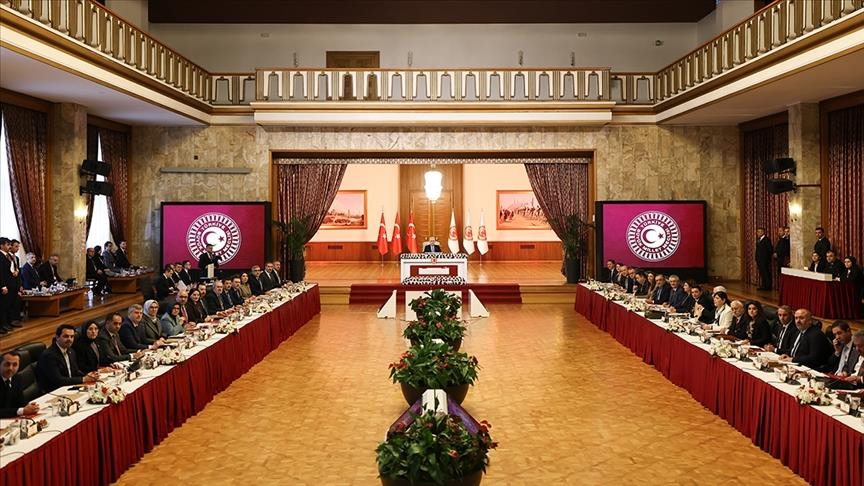
On the 18th of February, Turkey’s National Solidarity, Brotherhood and Democracy Parliamentary Commission met for its 21st session in order to vote on its final report.
Created in August 2025, the aim of the Commission was to strengthen social integration, consolidate national unity and sisterhood/brotherhood, and advance freedom, democracy, and the rule of law in the context of a renewed process for peace and democratization through the resolution of the Kurdish question in Turkey.
The report agreed upon by the Commission falls significantly short of expectations, failing to mention the “right to hope” and several other key topics discussed at length by the Commission. Prior the publication of the report, pro-democracy advocates have criticized the frequent references to “terrorism” and the framing of the ongoing process as “Terror-Free Turkey,” arguing that such language reflects a one-sided approach and does not contribute constructively to fostering dialogue toward a democratic solution for all peoples of Turkey. Regarding rights and freedoms, the DEM Party stressed the need to guarantee mother-tongue rights, cultural rights, and universal human rights – which are mentioned in general terms within the report, but without specific emphasis or clarity. They further emphasized the role of Abdullah Öcalan as the key architect and initiator of the ongoing process.
Nevertheless, the report was adopted with 47 votes in favor, two against, and one abstention. As such, it represents a key achievement and an important step toward democratization in Turkey. The essential work now begins: determining how the Commission’s recommendations—along with other key requirements of the peace process aimed at resolving the Kurdish question in Turkey—will be translated into concrete legislative reforms.
The seven central headings of the report are summarized below:
1. The work of the Commission
The Commission derives its institutional legitimacy from the Speaker of the Grand National Assembly acting as its Chair, a legitimacy that is further strengthened through the transparency of its proceedings.
The Commission’s work follows a consensus-based approach and is grounded in the values of democracy, participation and inclusiveness. The qualified majority mechanism ensures a functioning based on pluralism and on the culture of compromise, where a diversity of perspectives, demands, and concerns is aknowledged and integrated.
Through its mandate, the Commission compiled a comprehensive body of knowledge that informs the legal, historical, sociological, economic and psychological dimensions of the report, drawing on the information and opinions of 137 institutions and individuals. This ensures that the report reflects the broadest social consensus, providing a solid foundation for subsequent legal steps and social acceptance.
2. The fundamental objectives of the Commission
The fundamental objectives of the Commission include addressing issues of “terrorism”; strengthening social integration and national unity and promoting freedom, democracy and the rule of law; considering development and economic growth. .
3. The historical roots of Turkish–Kurdish brotherhood and the law of brotherhood
The report describes the shared history and deep connections between Kurds, Turks, and other peoples sharing the same geography. A lasting solution and peace, it proposes, depend on eliminating the root causes of conflicts, and the advancement of unity and integrity in which the experience of living together becomes the strongest foundation and possibility for a shared and prosperous future. In this sense, it advocates for an approach based on the law of brotherhood, aimed at reaching a social balance that accepts differences and at strengthening equality, pluralism and freedom, through planned and inclusive programs in different areas.
4. Areas of consensus among those heard by the Commission
The report underscores a broad consensus across different segments of society in favor of peace through the laying down of arms, as well as a shared vision of a future based on coexistence among the peoples of Turkey. It also identifies common ground regarding social consent and society’s sense of responsibility for the process. In addition, there is strong support for the principles of participation, transparency, and inclusiveness among political institutions, civil society, and academia.
The report further identifies the importance of adopting a holistic approach, in which democratization, equal citizenship, rule of law, and the security of rights and freedom, as well as economic development are considered alongside questions of disarmament.
Finally, regional and international considerations also figure strongly as points of consensus identified by the Commission, with the perspective of strengthening internal peace, regional stability, and Turkey’s role in global justice.
5. PKK’s dissolution and surrender of arms
The Commission proposes that disarmament should be supported by verifications processes in the field. The evaluation of the situation outside the borders is also presented as a security concern. Moreover, the need for a parallel, clear, predictable implementation of legal regulations to accelerate the disengagement and disarmament process is discussed. The need for a justice-based integration into society of those who disarm is also highlighted.
6. Legal regulation related to the process recommendations
A critical threshold is the identification and confirmation of the PKK’s disarmament and disbandment, which must operate in coordination between the relevant state institutions and according to objective, transparent, auditable criteria. In order to strengthen social integration, there is a need for a purpose specific, independent, and temporary legal regulation to manage the process and its aftermath, along with the laying down of arms. For this, it is recommended that an independent law be adopted in conjunction with the process of laying down arms as a way to strengthen democratic politics, reintegrate individuals who reject violence into society, and bring the issue into the legal and political sphere. The law should aim to integrate individuals in a fair, safe, and healthy manner.
It is emphasized, however, that such legal regulations should take into account public consciousness and social sensitivities, and not create the impression of impunity and amnesty within society. The report further advocates for the creation of a monitoring mechanism within the executive, and legal guarantees for those who participate in the process.
7. Recommendations related to the democratization
One of the main tasks of the Commission is to make recommendations on the steps needed to raise Turkey’s democratic standards. A well-functioning democracy needs a secure social and political space, where debates and negotiations can happen on the basis of tolerance and mutual respect. As a result, social cohesion will be strengthened, in a context where pluralism and diversity are preserved.
The recommendations highlight the following points: the importance of full compliance with the decisions of the ECtHR and the Constitutional Court; the strengthening of mechanisms that ensure full compliance with ECtHR and Constitutional Court rulings as well as the establishment of new ones; the removing of administrative obstacles to compliance with the rulings; the revision of legislation on the execution of judgements in line with the case law of the ECtHR, the Constitutional Court and international treaties to which Turkey is a party, with the aim of having a fairer approach to sentencing and detention; the revision of the structure and decision-making processes of prison administration and observation boards; the revision of legislation relating to freedom of expression, assembly and demonstration; the recommendation of a new political parties law, of new election laws and of a political ethics law; the promotion of a more democratic organisation of the administrative system based on higher legal standards; the amendment of legislation so that, in the event that a mayor is removed from office, the election for their replacement will be conducted solely by the municipal council.
The Commission’s report is not binding, but offers suggestions and a framework for democratisation to be later taken up by the parliament in drafting new legislation. It represents therefore a first step among many needed towards democratic integration and peace through the resolution of the Kurdish question.