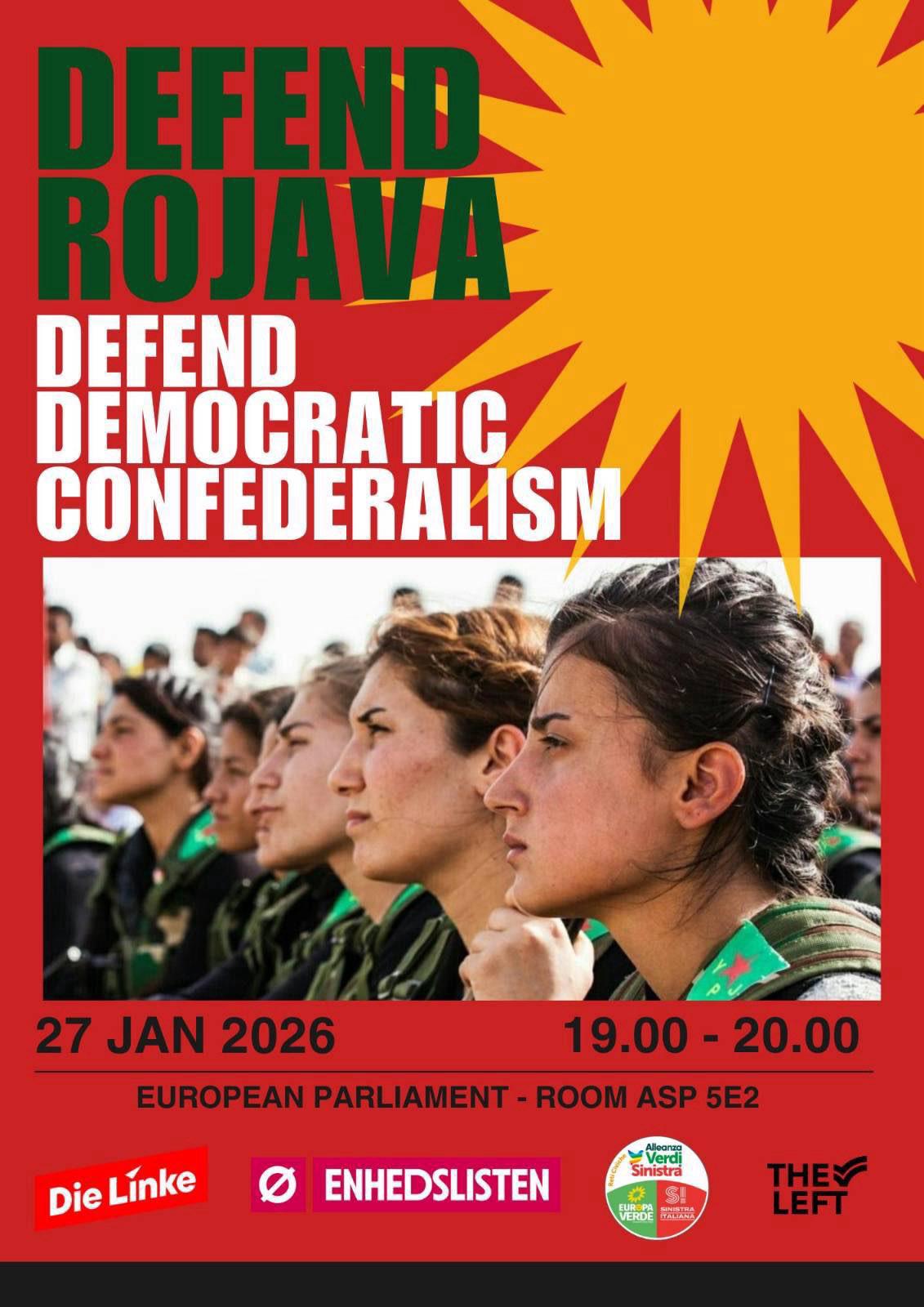
Upcoming Event in European Parliament: Defend Rojava: Defend Democratic Confederalism
On the 27th of January from 19:00-20:00, an event titled “Defend Rojava, Defend Democratic Confederalism” will be held in the European Parliament in Brussels, co-hosted by political parties Sinistra Italiana, Die Linke, and Enhedslisten. The event will focus on recent existential threats to Kurdish communities and the Autonomous Administration of North and East Syria. Speakers will include:
– Ilaria Salis (MEP – Sinistra Italiana)
– Ozlem Alev Demirel (MEP – Die Linke)
– Per Clausen (MEP – Enhedslisten; Chair of the Kurdish Friendship Group)
– Eyyup Faruk Doru (DEM-PARTI)
– Sinan Önal (Foreign Relations Commission of the Kurdistan National Congress)
– Shiyar Ali, Representative of the Autonomous Administration to Europe
– Rwaida Al Harfoush, Representative of the Druse
– Maysoon Majidi (Kurdish refugee in Italy, Associazione Tre Dita)
– Maria Edgarda Marcucci, activist and writer
– Ludovica Intelisano (Academy of Democratic Modernity)
Please Register here to attend: https://left.eu/defend-rojava-defend-democratic-confederalism-registration-page
Attacks on Kurdish Communities in Syria: Attempts at ethnic cleansing and mass forced displacement
What began between 6 and 11 January as military assaults by the forces of the Syrian Transitional Government (STG) together with allied jihadist militias on the predominantly Kurdish civilian neighbourhoods of Sheikh Maqsoud and Ashrafiyeh in Aleppo has now spread across Kurdish regions of North and East Syria (Rojava). Reports from the ground highlight the support of Turkey in logistics and coordination of such attacks, while Turkish military forces have amassed on the border with Kobane. There is growing evidence of widespread human rights violations, including actions by forces of the Syrian Transitional Government that may amount to war crimes or crimes against humanity.
Forces of the Syrian Transitional Government have also attacked prisons run by the Syrian Democratic Forces (SDF) and the International Coalition that were holding ISIS fighters, resulting in the release of thousands of detainees. The International Coalition, stationed only kilometres away, remained silent and took no action to prevent these releases. This represents a grave security risk for the peoples of the region and beyond, enabling ISIS fighters to resume atrocities similar to those committed at the height of the war against ISIS.
The city of Kobanê, the historic symbol of the world’s victory against ISIS, has been placed under a state of life-threatening siege. On one front, it is encircled by the forces of the Syrian Transitional Government and their allied jihadist militias. On the other, it is sealed off by the state that stands as their principal and most structurally embedded patron: Turkey. It provides decisive logistical and military backing along the border. Together, these actors have systematically cut all civilian lifelines, subjecting the city’s 150,000 residents to an enforced isolation that amounts to deliberate and sustained civilian deprivation.
The cutting off of basic resources—water, electricity, fuel, food, medical supplies—is creating a rapidly escalating humanitarian crisis. In the last days, four children have frozen to death. The city’s capacity is shattered: over 80% lack clean water, and medical facilities are operating below 10% capacity. The crisis has been dramatically compounded by a massive, sudden influx of displaced civilians. In the last week alone, over 18,000 people fled to Kobanê following attacks by the jihadist forces led by al-Sharaa on the regions of Raqqa and Tabqa. They now join tens of thousands of others sheltering in a city under siege, with many forced to sleep in the open in sub-zero temperatures.
These attacks threaten the achievements of the the last 15 years of the Autonomous Administration of North East Syria , including advances in women’s liberation, peaceful coexistence among diverse communities, and democratic self-governance. The silence of the International Coalition and other state and international actors amounts to complicity in the violence being perpetrated by al-Sharaa’s forces on the ground. They risk enabling a resurgence of ISIS and have already begun opening the door for its fighters to resume massacres against the region’s populations, which will likely have global implications.
On an international level, there has been a strong reaction of solidarity with the peoples of Rojava from social and labor movements, as well as political parties on local, national, and EU levels. On the 14th of January, MEP Mélissa Camara (Verts/ALE) submitted written questions to the vice-President of the Commission / High Representative of the Union for Foreign Affairs and Security Policy regarding what steps the EU would take in insisting on effective protection for Kurdish civilians, the provision of humanitarian aid, an end to arbitrary arrests and respect for international humanitarian law. Statements of solidarity denouncing attacks on Kurdish communities have been signed by hundreds of academics and political figures. However, a worrying silence on the part of international institutions remains, especially concerning given the EU Commission’s recent announcement that of a new political partnership and funding package of 620 million euros would be provided by the EU to Syria in 2026.
Turkey
In Turkey, there have been widespread protests organised both in metropoles and within Kurdish regions in solidarity with Rojava, and condemning the Turkish government’s complicity in the attacks. On several occasions, police and local authorities responded to these protests with heavy repression, using physical violence and tear gas against protestors.
In the context of over a year of efforts toward peace through democratisation and the political resolution of the Kurdish question, developments in Syria raise significant concerns about the government’s readiness to in good faith address consistent human rights violations and policies of ethnic cleansing against Kurdish populations—both domestically, and in the broader region.
Iran
The NGO Human Rights Activists in Iran (HRAI) published a new statement on the protests in Iran and Rojhilat Kurdistan. According to the report, at least 5,459 people were killed by Iranian state forces during protest actions across Iran and in Rojhilat Kurdistan. In addition, at least 40,887 protesters were detained and 7,403 protesters were injured. The actual numbers may be significantly higher Despite the severe crackdown on dissent, and limits on internet, the protests continue to spread and intensify.